1. Product Introduction
A dry mix mortar plant is a fully integrated automated production
system designed for industrialized manufacturing of dry pre-mixed
mortars. It realizes standardized, large-scale, and continuous
production by completing automatic raw material storage, precise
batching, quantitative feeding, high-efficiency mixing, finished
product storage, and automatic packaging in one closed production
line. Different from scattered manual mortar mixing on construction
sites, the dry mix plant adopts centralized factory production
mode, which completely solves the problems of inaccurate manual
proportioning, unstable product quality, serious dust pollution and
low production efficiency in traditional on-site mixing.
Equipped with core processing units including aggregate drying and
sieving system, powder silo storage system, PLC intelligent
batching system, high-precision mixing unit, and automatic
packaging & conveying system, the whole plant can process various
raw materials such as dried quartz sand, cement, gypsum, mineral
powder, and trace polymer additives. After uniform dry mixing, it
produces finished dry mortar products that can be directly used
after on-site water mixing. Widely applicable to civil
construction, municipal engineering, decoration and thermal
insulation projects, the dry mix plant has become the mainstream
standardized production equipment for modern green building
materials.
2. Core Highlights
2.1 Intelligent Precision Batching, Stable Product Quality
The dry mix plant adopts fully automatic weight-based batching
technology with high-precision sensor modules, realizing accurate
metering of main materials and trace additives. The batching
accuracy of bulk materials reaches ±0.5%, and the metering error of
micro-functional additives is controlled within ±0.1%. The whole
production process is digitally controlled without manual
intervention, ensuring consistent raw material proportion of each
batch of mortar. It effectively avoids quality fluctuations such as
uneven strength, poor adhesion and inconsistent construction
performance caused by manual proportioning errors, realizing
standardized and unified finished mortar quality.
2.2 Closed Fully Automatic Production, Green & Environment-Friendly
The entire production line adopts a fully closed structural design
from feeding, mixing to discharging and packaging, equipped with
centralized pulse dust removal equipment. It thoroughly eliminates
flying dust and material leakage during production, meeting
international environmental protection emission standards. The
automated assembly line operation greatly reduces manual
participation, lowers labor intensity and labor costs, and realizes
clean, low-noise and low-pollution factory production, which is in
line with the development trend of green and intelligent
construction industry.
2.3 High Production Efficiency & Wide Formula Compatibility
Optimized production process flow and modular unit design eliminate
redundant production links, supporting 24-hour continuous stable
operation. The production capacity ranges from small-scale 1TPH to
large-scale 20TPH and above, meeting the production needs of
different-scale manufacturers. The system supports free switching
of dozens of mortar formulas, including ordinary building mortar
and special functional mortar. It can flexibly produce plastering
mortar, bonding mortar, waterproof mortar, thermal insulation
mortar, self-leveling mortar, putty powder and other products, with
strong production flexibility and wide market adaptability.
2.4 Modular Integrated Design, Easy Installation & Expansion
The dry mix plant adopts standardized modular integrated layout,
with compact overall structure and small floor area. Compared with
traditional scattered production lines, it features fast on-site
installation and commissioning, short production cycle and quick
production launch. The modular design supports personalized
function expansion and capacity upgrading. Users can add silo
units, dust removal systems, automatic palletizing equipment and
other auxiliary modules according to production demand growth,
realizing incremental investment and effectively saving production
site and equipment investment costs.
2.5 Durable Structure & Low Operation Cost
Key equipment and conveying parts are made of high-strength
wear-resistant materials, with anti-corrosion and anti-wear
treatment, ensuring long-term stable operation of the production
line. The optimized power matching and energy-saving transmission
structure reduce unit power consumption. The intelligent fault
self-detection system can timely identify equipment abnormal
conditions, reduce failure rate and downtime loss. The whole line
has low daily maintenance cost and long service life, with
excellent cost-performance and stable operation benefits.
3. Standard Specification Parameters
Dry mix mortar plants are divided into mini, small, medium and
large models to adapt to different production scales. The unified
standard core parameters are listed below:
| Parameter Item | Standard Technical Specification |
|---|
| Production Capacity | 1–20 TPH (customizable super-large capacity) |
| Batching Accuracy (Bulk Materials) | ±0.5% |
| Batching Accuracy (Micro Additives) | ±0.1% |
| Single Batch Mixing Cycle | 3–8 minutes |
| Mixing Uniformity | ≥98.5% |
| Total Installed Power | 30KW–160KW (model dependent) |
| Working Mode | Fully automatic PLC control / Semi-automatic optional |
| Dust Removal Mode | Centralized pulse dust removal, zero dust emission |
| Packaging Specification | 20–50kg/bag (customizable) |
| Operation Environment | Indoor factory, adaptable to -20℃~60℃ |
| Floor Area | 80–300㎡ (modular adjustable) |
4. Usage Precautions
4.1 Pre-Production Inspection & Preparation
Before starting the dry mix plant, conduct a comprehensive
inspection of all system units. Check whether the raw material
silos, conveying pipelines, batching sensors and mixing host are in
normal state, and confirm that there is no foreign matter blocking
the pipeline and equipment. Calibrate the batching metering system
regularly to ensure accurate metering data. Inspect the tightness
of equipment seals and the working state of the dust removal system
to avoid dust leakage. Check the lubrication of transmission
motors, reducers and bearings, and replenish lubricating oil and
grease in time to ensure stable mechanical operation.
4.2 Standard Feeding & Production Operation
Strictly follow the formula parameters set by the system for raw
material feeding, and prohibit arbitrary modification of batching
parameters during operation to avoid unqualified mortar quality.
Ensure the dried aggregate moisture content meets production
standards; wet raw materials are forbidden to enter the production
line to prevent material caking and pipeline blockage. Operate the
equipment in accordance with the startup sequence of first empty
load operation then load production. It is forbidden to overload
production and long-term empty load operation to avoid equipment
wear and power waste. Do not open the equipment access door during
high-speed operation to prevent safety accidents.
4.3 Real-Time Operation Monitoring & Management
Monitor the system operation data in real time through the PLC
control screen during production, including batching data,
operating current, equipment vibration and temperature. Once
abnormal alarm, current overload or material blockage occurs, stop
the machine immediately for troubleshooting. Avoid frequent
switching of production formulas and startup/shutdown operations in
a short time to protect the control system and power components.
Record production data daily to facilitate production quality
traceability and equipment operation analysis.
4.4 Daily Cleaning & Regular Maintenance
After daily production, thoroughly clean the residual materials in
the mixing host, conveying pipes and discharging ports to prevent
material moisture absorption and caking, which will affect the next
production accuracy. Regularly clean the dust removal filter
cartridge and dust collection box to ensure the dust removal effect
and unobstructed air circulation. Inspect wearing parts such as
mixing blades, lining plates and conveyor belts monthly, and
replace severely worn parts in time. Regularly check the circuit
and pipeline system to eliminate potential safety hazards.
4.5 Long-Term Shutdown & Safety Specifications
If the production line is shut down for more than 7 days,
thoroughly clean all equipment interiors, drain residual moisture,
and apply anti-rust treatment on metal wearing parts. Cut off the
total power supply and cover the equipment with dust-proof cloth
for protection. All operators must receive professional safety
training and master emergency shutdown procedures. Equipment
maintenance and overhaul must be carried out after power cutoff and
hanging warning signs. The production workshop shall be equipped
with fire prevention, dust prevention and explosion-proof
facilities to ensure safe standardized production.
5. Application Scenarios
5.1 Civil Construction Engineering Production
It is widely used in centralized production of various ordinary
building mortars for residential buildings, commercial buildings,
office buildings and other civil projects, including internal and
external wall rendering mortar, masonry mortar, floor leveling
mortar and repair mortar. It provides high-quality and stable
standard mortar materials for large-scale construction projects.
5.2 Special Functional Mortar Manufacturing
The production line supports the production of high-performance
special mortars for professional engineering scenarios, covering
tile adhesive, waterproof mortar, anti-crack fiber mortar, external
wall thermal insulation mortar, grouting mortar and floor
self-leveling mortar. It meets the high-standard material
requirements of decoration engineering, waterproof engineering,
thermal insulation energy-saving engineering and bridge road
engineering.
5.3 Building Material Factory Mass Production
Suitable for professional dry mortar production factories and
building material supporting enterprises, realizing standardized
batch production of diversified dry powder building materials. With
flexible formula switching and stable output, it can continuously
supply qualified dry mortar products for building material markets,
distributors and construction units, supporting large-scale
industrial production.
5.4 Municipal & Infrastructure Projects
Adapt to the material production demand of municipal road
reconstruction, pipeline engineering, landscape engineering and
infrastructure supporting projects. The factory pre-mixed dry
mortar features convenient transportation, simple on-site
construction and stable performance, which can effectively improve
the construction efficiency and engineering quality of municipal
projects.
5.5 Customized Small-Batch Production
The flexible modular dry mix plant can meet the small-batch and
multi-variety customized production needs of special engineering
projects and small and medium-sized enterprises. It can quickly
adjust production formulas to produce special customized mortars
for special construction environments and special process
requirements, with strong market flexibility.
6. Common FAQ
Q1: What are the advantages of dry mix plant production over
traditional on-site mortar mixing?
A1: Traditional on-site mixing relies on manual proportioning with
large errors, unstable mortar quality and serious dust pollution.
The automatic dry mix plant adopts intelligent precise batching and
closed integrated production, with accurate material proportion,
uniform mixing and stable product quality. It greatly reduces dust
pollution and labor costs, improves production efficiency, and
realizes standardized and green production, which fully meets
modern engineering construction quality and environmental
protection standards.
Q2: Why does the finished mortar have uneven strength and unstable
performance?
A2: The main causes include inaccurate batching sensor calibration,
residual caking materials in the mixing host, excessive moisture of
raw aggregate, and incorrect formula parameter setting. Solutions:
regularly calibrate the metering system, clean residual materials
thoroughly before production, strictly control raw material
moisture content, and confirm formula parameters before each
production to ensure standardized operation.
Q3: How to solve dust leakage and excessive dust in production?
A3: Dust leakage is mainly caused by aging equipment seals, blocked
dust removal filter cartridges or loose pipeline connections. It is
necessary to regularly replace sealing accessories, clean or
replace dust removal filter elements, and check and fasten all
pipeline connections. Ensure the dust removal system is started in
advance before production to maintain negative pressure dust
removal state inside the equipment, realizing zero dust emission.
Q4: Can the dry mix plant realize formula customization and
flexible switching?
A4: Yes. The PLC intelligent control system can store dozens of
preset mortar formulas. Users can freely switch formulas with one
click according to production needs, and can also modify and
customize new formulas. The production line can adapt to the
production of ordinary mortars, special functional mortars and
various powder building materials, with extremely high production
flexibility.
Q5: What is the daily maintenance cycle and key maintenance items?
A5: Daily maintenance includes equipment cleaning and dust removal
system inspection; weekly maintenance includes lubrication of
transmission parts and pipeline inspection; monthly maintenance
includes inspection and replacement of wearing parts such as mixing
blades and lining plates, and calibration of batching sensors.
Regular maintenance can effectively reduce failure rate and extend
the long service life of the whole production line.
Q6: What factors affect the production capacity of the dry mix
plant?
A6: The main influencing factors include raw material moisture
content, formula complexity, equipment operation proficiency, and
daily maintenance status. Excessively wet raw materials will slow
down feeding and mixing efficiency; complex formulas with various
trace additives will appropriately extend the mixing cycle.
Standardized operation and regular maintenance can maximize the
continuous production capacity of the equipment.
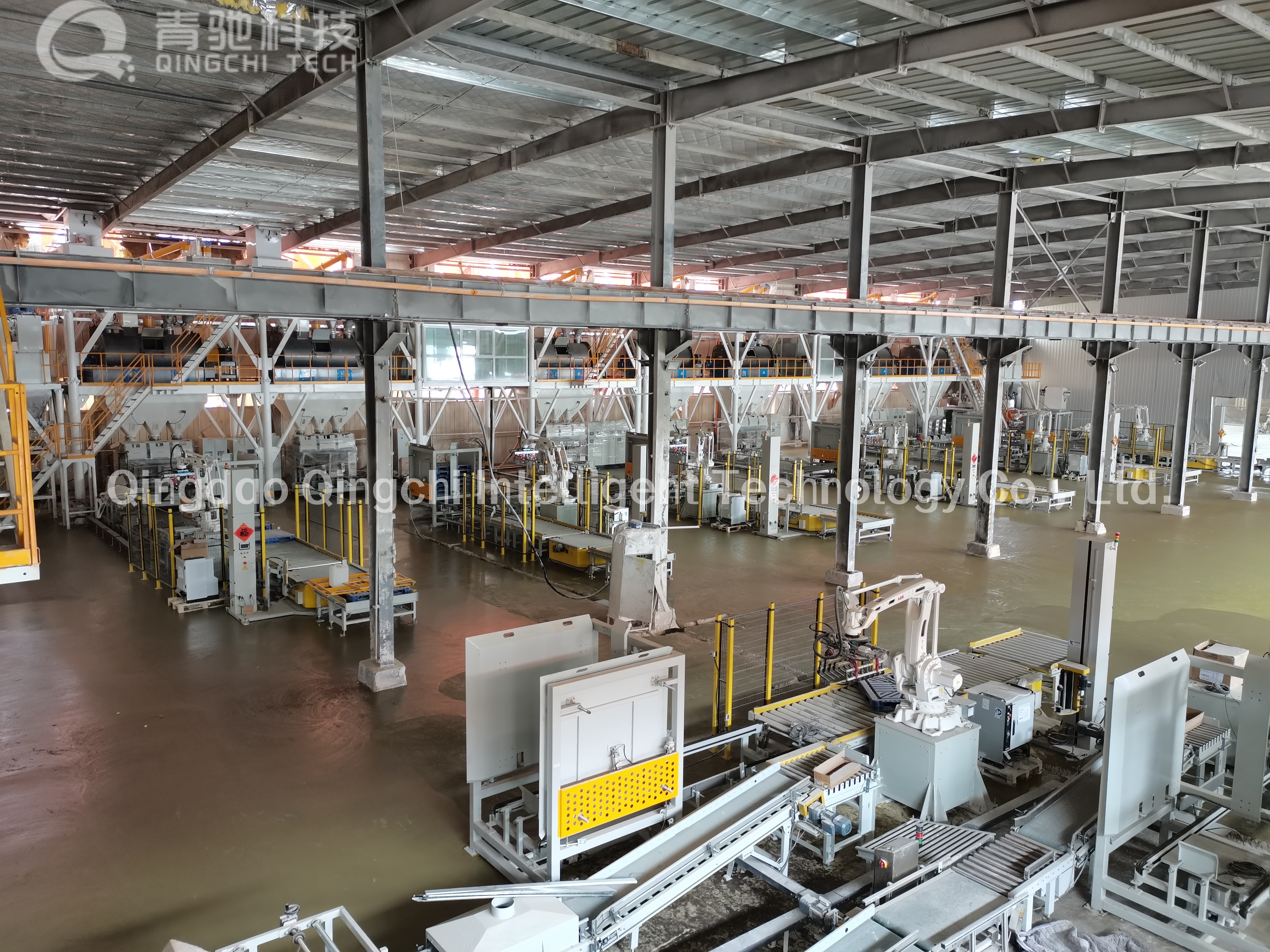


 20-30Ton/Hour Dry Mortar Production System Full Automatic Dry Mortar Plant

