| Sign In | Join Free | My chinacomputerparts.com |
|
| Sign In | Join Free | My chinacomputerparts.com |
|
| Categories | Steel Smelting Equipment |
|---|---|
| Place of Origin: | Shaanxi, China |
| Brand Name: | AE |
| Price: | Negotiation |
| Certification: | CE;ISO9001;ISO14001;OHSAS 18001 |
| MOQ: | 1 |
| Delivery Time: | 30-90work days |
| Type: | Arc Furnace |
| Use: | Melting Furnace |
| Warranty of core components: | 1 Year |
| Core Components: | PLC |
| Key Selling Points: | Competitive Price |
| Company Info. |
| Xi'an Abundance Metallurgical Equipment Co., Ltd. |
| Verified Supplier |
| View Contact Details |
| Product List |
Basic Oxygen Furnace
Top Blown Process (BOP)
In the top blown process a water cooled oxygen lance is lowered
from the top of the furnace and blows oxygen at supersonic speed
into the melt. The majority . steelmakers utilize top-blown oxygen
steelmaking.
Bottom Blown Furnace (Q-BOP)
In the bottom-blown processes, oxygen is introduced through a number of tuyeres in the bottom of the furnace. In the Q-BOP process, the oxygen tuyeres are cooled by injecting hydrocarbon gas through an outer pipe surrounding the oxygen pipe. Most bottom-blown processes use methane or propane as the hydrocarbon coolant, but fuel oil is also used. A principle advantage of the Q-BOP process is that it reduces the height requirements of the process allowing a lower profile building to be constructed.Combination Processes
One class of combination blown process uses top-blown oxygen with
inert gas (argon and Nitrogen) injection through the bottom by
means of tuyeres or permeable elements. In the second class of
combination furnaces, there are both top and bottom oxygen lances;
the bottom lances can also be used for inert gas injection during
stirring.
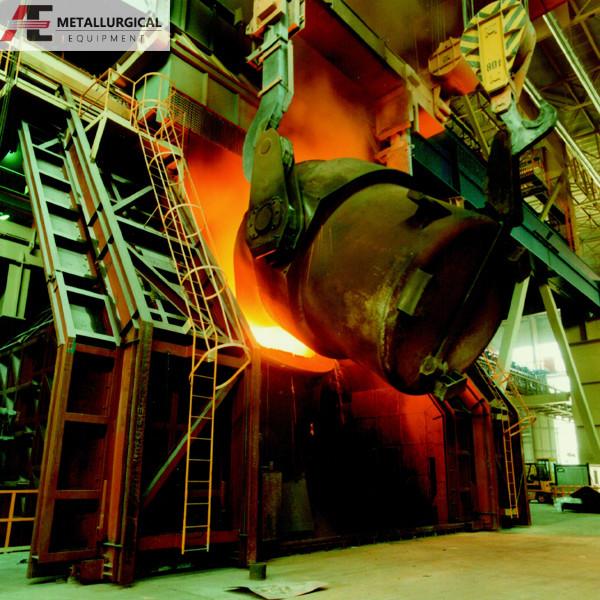
The basic oxygen furnace (BOF), whose profile is shown in the
figure, is a tiltable vessel lined with refractories such as
magnesia carbon brick. Auxiliary equipment includes a chute for
scrap charging, hoppers for alloys and fluxes, a lance for
injecting pure oxygen gas, a sublance for measuring the temperature
and carbon concentration of the molten steel, lifting devices for
the lance and sublance, equipment for tilting the vessel, and
equipment for recovering and cleaning the exhaust gas. The BOF
capacity is expressed as the weight of crude Steel that can be
decarburized per heat. Most BOFs in Japan have a capacity of
150-300 tons.
The main function of the BOF is to decarburize the hot metal using
pure oxygen gas. In the top-blown BOF, pure oxygen is injected as a
high-velocity jet against the surface of the hot metal, allowing
penetration of the impinging jet to some depth into the metal bath.
Under these conditions, the oxygen reacts directly with carbon in
the hot metal to produce carbon monoxide. The pure oxygen top-blown
BOF can decarburize 200 tons of hot metal from 4.3% C to 0.04% C in
about 20 minutes. As a result of this high productivity, the BOF
replaced the open hearth furnace, which was a much slower process.
The injected pure oxygen gas first oxidizes silicon and then carbon
in hot metal. When the carbon concentration of the hot metal is
decreased to about 1%, the oxidation of Iron begins in parallel
with that of carbon. The oxidation of Iron becomes marked at carbon
concentrations of less than 0.1%, decreasing both the oxygen
efficiency for decarburization and the decarburization rate, while
increasing Iron loss into the slag. The problem with the top-blown
BOF is thus the oxidation of Iron when a low carbon concentration
is reached, and the resulting decrease in the decarburization rate.
When the Iron oxide content of the slag increases excessively, it
can react too quickly with carbon in the molten Steel and cause
sudden gas evolution, forming a mix of slag and molten Steel that
sometimes erupts from the vessel in a phenomenon called "slopping"
or "spitting".
The use of an oxygen lance with multiple holes at the tip has
proven very effective in delocalizing the oxygen supply and
increasing the decarburization rate while restraining excessive
oxidation of the molten Steel and preventing slopping and spitting.
However, the effectiveness of this lance was still inadequate, and
the bottom-blown oxygen process was developed, in which pure oxygen
gas is injected into the molten Steel from the bottom of the BOF.
The bottom blowing enhances the stirring of the hot metal and
thereby shortens the average mixing time in the molten Steel bath,
and promotes transport of solute carbon in the bath, preventing the
over-oxidation of slag, which is the cause of slopping and
spitting. Consequently, the bottom blowing enhances decarburization
efficiency, especially at low carbon concentrations. The
bottom-blowing is performed with bottom tuyeres of concentric
double-wall pipe. The inner pipe is used to blow pure oxygen gas
along with pulverized limestone as a slag-forming agent, while
propane gas is blown through the outer pipe as a coolant to prevent
tuyere burn back, since propane undergoes an endothermic reaction
during decomposition, which results in cooling and reduced burning
of the tuyeres. These improvements have made the production of
low-carbon steels much easier.
The top-and-bottom blown BOF, which combines the advantages of both
types of BOF, has recently become prominent in oxygen Steel making
The combined blowing BOFs mostly use bottom-blown inert gases in
place of oxygen gas for stirring. Various methods of bottom-blowing
have been adopted. As one example, a ceramic plug with embedded
multiple small pipes or multiple slits is used in the bottom
tuyeres. Irrespective of the type of the BOF, the exhaust gas,
which is high in CO content, is either combusted in the throat of
the BOF and passes through a waste-heat boiler installed in the
upper part of the throat to recover the sensible heat and the heat
of combustion, or is recovered un combusted through exhaust-gas
recovery equipment

|
 Electric Arc Furnace EAF for Steel Melting 10T-150T Made in Manufacturing Plant
Electric Arc Furnace 10T-150T Frequency Control for Smelting Iron and Steel State-of-the-Art Design
Electric arc furnace 10T EAF 15T Ladle Refining Furnace and Affordable Cast Iron Melting with Competitive
Electric Arc Furnaces for Steel Production Line Steel Melting Furnace Suppliers 3T-150T and 800kW Power Power kW 800
Electric Arc Furnace EAF for Steelmaking and Continuous Casting in Large Capacity
Electric Arc Furnace 100ton Scrap Melting EAF Continuous Casting Rebar Foundry for Competitive within Manufacturing Plant
Electric Arc Furnace 5T-150T EAF/Ladle Refining Furnace LRF with Competitive and Weight T 100 T
Electric arc furnace Industrial Steel Production Arc Furnace 5 Ton 10 Ton 20 Ton-120 Ton with 800kW Power
Electric Arc Furnace Graphite Electrode for 5-150 Ton Refractory Arc Furnace High Capacity and Durability
Electric arc furnace Competitive Design Industrial Electric Arc Furnace for Steelmaking 3T 5T 10T 15T 20T
Electric Arc Furnace EAF for Steel Melting 10T-150T Made in Manufacturing Plant
Electric Arc Furnace 10T-150T Frequency Control for Smelting Iron and Steel State-of-the-Art Design
Electric arc furnace 10T EAF 15T Ladle Refining Furnace and Affordable Cast Iron Melting with Competitive
Electric Arc Furnaces for Steel Production Line Steel Melting Furnace Suppliers 3T-150T and 800kW Power Power kW 800
Electric Arc Furnace EAF for Steelmaking and Continuous Casting in Large Capacity
Electric Arc Furnace 100ton Scrap Melting EAF Continuous Casting Rebar Foundry for Competitive within Manufacturing Plant
Electric Arc Furnace 5T-150T EAF/Ladle Refining Furnace LRF with Competitive and Weight T 100 T
Electric arc furnace Industrial Steel Production Arc Furnace 5 Ton 10 Ton 20 Ton-120 Ton with 800kW Power
Electric Arc Furnace Graphite Electrode for 5-150 Ton Refractory Arc Furnace High Capacity and Durability
Electric arc furnace Competitive Design Industrial Electric Arc Furnace for Steelmaking 3T 5T 10T 15T 20T

